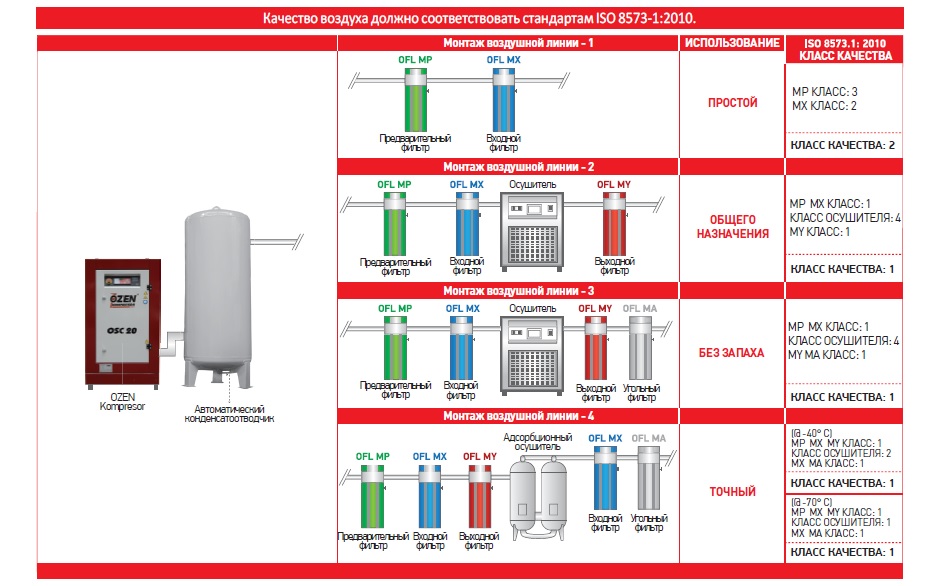
Compressed air filtration
Proper air preparation significantly improves the of reliability process and machine performance. Particles of dust, water and oil in a compressed air reduces the service life as well as functionality of the components and systems. They also reduce the productivity and energy efficiency.
Why is it necessary to filter compressed air?
One cubic foot of compressed air can contain millions of particles of dirt, a significant amount of water and oil and even heavy metals, such as lead, cadmium and mercury. If they are not filtered, the uninterrupted operation of system components such as valves and cylinders, cannot be guaranteed in the long term. Poorly prepared compressed air can contaminate the control valves and cause seals swell and wearing out prematurely. Thus, the correct preparation of compressed air is necessary to reduce machine downtime, maintenance costs and energy consumption.
Variables of the preparation of compressed air
For the air preparation, there are three variables: the purity, the amount (consumption) and the pressure of the compressed air. Depending on the system requirements, the coordination of these three variables provides high quality compressed air and a basis for selection the proper components of the service block. Required purity of compressed air increases both performance and efficiency of pneumatic systems, as well as ensures regulatory requirements compliance. The amount of consumption is mainly determined by flow sections and the design dimensions of the machine. In general, the larger components have higher flow rate. Optimized working pressure increases efficiency, minimizes wear and reduces energy consumption. For coordination of purity, quantity and pressure of compressed air for technical system characteristics, you must select the correct individual components. This includes on / off valves, pressure boosting valves, pressure regulators, water separators, filters and drying plants.
Types of filters and air processing equipment
There are different types of air processing components for removal such contaminants as solid, liquid water, steam vapors and oils, odorants and even bacteria and viruses. Most automation applications focus on removal of solid particles and water.
Separators of water remove condensate with a centrifugal construction or with the principle of coalescence.
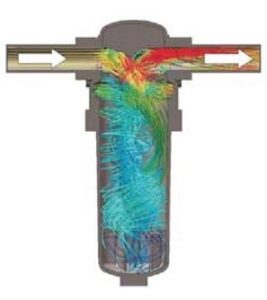
The centrifugal separator causes rotational movement in the air, causing the particles to accelerate in the radial movement outward. Once they reach from outside, they merge into bowl. They are effective for removing water droplets, as well as dust particles and dirt more than 5 microns in size. This process does not require any maintenance.
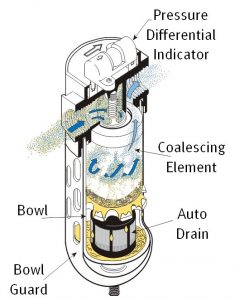
Coalescing separator passes air from inside to outside the filter element. These cartridges must be regularly replaced.
Filters are used for eliminating solids, condensate and oil.
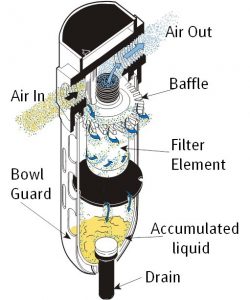
The coarse / soot type filters have a pore size of 5-40 microns. Air flows through a centrifugal separator, and then through filtering element. Filter elements often represent a sintered material such as polyethylene or bronze.
Small and microfilters remove particles of size less than 1 micron: up to 0.01 micron. Air flows through the filter cartridges from the inside out. Solids stuck in filter cartridge and clog it. Particles of a liquid such as condensate or oil, merge or join larger drops that flow out and enter the filter. It is important to replace filters to avoid premature clogging of the filtering element. For example, if 1-micron filtering is required, it is recommended to use a 5-micron filter upstream, so that the 1-micron filter is not clogged by large particles.
Filters with activated carbon bind hydrocarbon residue, odorants and oil vapors.
Sterile filters ensure that air does not contain microbes.
Dryers are used to remove water vapor beyond possibilities of micronized and micro-coalescing filters and are classified according to the pressure dew point (PDP) that can be achieved by them. The dew point under pressure determines the temperature at which the compressed air can be cooled without condensation of water. If temperature is below the pressure dew point, condensate forms. Even if the temperature will be subsequently increased, this condensate will remain and can lead to corrosion of components.
- Refrigeration dryers are usually located lower than the compressor unit in flow. The air in the refrigeration unit is cooled to the temperature above zero, so condensate falls out and merges. The reached pressure dew point is about 37°F (3°C). To avoid condensation, it is recommended that the dew point under the pressure was set to 50°F (10°C) – below the ambient temperature, so the refrigeration dryer is sufficient for systems whom temperature never falls below 55°F (13°C),
- Membrane dryers suppress the pressure dew point to the inlet conditions. Air flows longitudinally through the beam of parallel hollow fibers. Through this process, water vapor diffuses due to partial pressure drop from inside the fibers out. The steam is emitted by air flow. Because of the purge a membrane dryer has a certain amount of constant air flow.
- Adsorption dryers are used if dew point from -40°F (-40°C) to -94°F (-70°C) pressure needed. Dryers use molecular forces to bind gas or vapor molecules with a dryer element such as desiccant granules. Since the dryer element is regenerating, two chambers are needed. While drying occurs in one, the dehumidifier has time for cold or warm regeneration in the other. In devices with a cold regeneration, some of the dry air is used to dry the adhesive element. If thermal regeneration is used, the water evaporates because of the heating. The dryer must be replaced periodically.
Types of drains for filter units
Several various types of drains are available for filter units:
- Manual: the condensate is drained manually, twisting the drain cork. They require a regular maintenance schedule.
- Semi-automatic (normally open): this typeof drainage opens as soon as the compressed air is turned off.
- Fully automatic (normally open): thisdrainage typeopens as soon as the compressed air is turned off or a determined level in the bowl is reached.
- Fully automatic (normally closed): opens as soon as the compressed air is turned on or a certain level in pan is reached.
- Electric drains: can be opened/closed remotely using an electrical signal.
Proper maintenance of filter elements
To ensure efficient operation of filters, filter elements must be replaced periodically. How often it needs to be done depends on such parameters as the quality of the supply air and the number of hours of machine operation. As one of the approaches, you can define and establish a preventive maintenance schedule that means a replacement of filter elements every 6 months.
A more reliable method is the use of differential pressure sensors, which measure the pressure drop between inlet and outlet pressure of the filter. The pressure decline indicates that filter is clogged. It may be electrical sensors that send signal and notify the operator, visual indicators on the filter block itself.